Writing
Learn and earn: my AppleCentre years
· Career
In short: I left school at 16 and started at AppleCentre Preston on a training scheme. I went from packing boxes to selling Macs in the showroom, and learned that you don’t need to be an expert to explain technology well. You just need to understand it, be honest and fit it to what people actually need.

In my AppleCentre Preston sweatshirt, early 1990s.
Learn and earn
I left school at 16. I didn’t want to go to college or university. I wanted to get out there, earn some money and do something I was interested in. Learn and earn, as I’ve come to call it.
I was lucky enough to get a Youth Training Scheme place, a government programme that let school leavers train on the job. My placement was at AppleCentre Preston, a shop that sold Apple Macintosh computers. For two years I worked there four days a week and spent one day a week at college, working towards NVQ (National Vocational Qualification) Levels 2 and 3 in retail sales, as I remember it.
Packing boxes by day, teaching myself at home
For those first two years I worked in the packing department. I collected orders from the sales team, took in deliveries from suppliers, picked the goods for each order and boxed them up. When the courier arrived, I made sure every parcel was signed off.
In my own time I had a Macintosh Plus at home, and I taught myself how to use it.
My first computer had been a Sinclair Spectrum, followed by an Atari ST. I hadn’t used a PC or Windows yet. The Mac felt different. It was a proper business computer, and it was surprisingly easy to pick up. You pointed and clicked, and it mostly made sense.
Command-C to copy, Command-V to paste, Command-X to cut and Command-Z to undo. More than 30 years later, they’re still second nature. When I later used Windows 3.1 and then Windows 95, the same shortcuts were mostly there, with the Command key swapped for Control. That always made me smile. It reminded me of a line often credited to Picasso and famously quoted by Steve Jobs: “Good artists copy, great artists steal.”
Full-time at 18
Once I’d passed my qualifications, AppleCentre Preston took me on full-time. I was 18 and earning £100 a week, as I remember it.
I stayed mostly in packing for about another year. Then, gradually, over a couple of years, I was trained to do demonstrations and help out in the showroom. I also took overflow phone calls, which got me used to talking to customers.
I was on the sales side. A dedicated support team handled technical support and repairs, and I didn’t have their experience.
The showroom
AppleCentre Preston did a lot of work with education. It had relationships with universities, both local and across the UK, and in those days it was very much a business built on who you knew. A university might buy around 30 machines for a computer lab. Those had to be delivered, set up, tested and then supported.
The showroom was large, with several demonstration stations. One was for desktop publishing, which means designing pages for print on a computer rather than by hand. It had huge 21-inch monitors, at a time when 13 inches was normal. Colour on a computer was a big deal.
To learn the more sophisticated software, I bought my own Macintosh II with a colour monitor. I played with Aldus PageMaker and QuarkXPress, two desktop publishing programs of the time. PageMaker was the easier of the two, so that’s the one I spent most time with.
I’m not a designer, though. I know when I like something, but I couldn’t create it myself. That’s still true today.
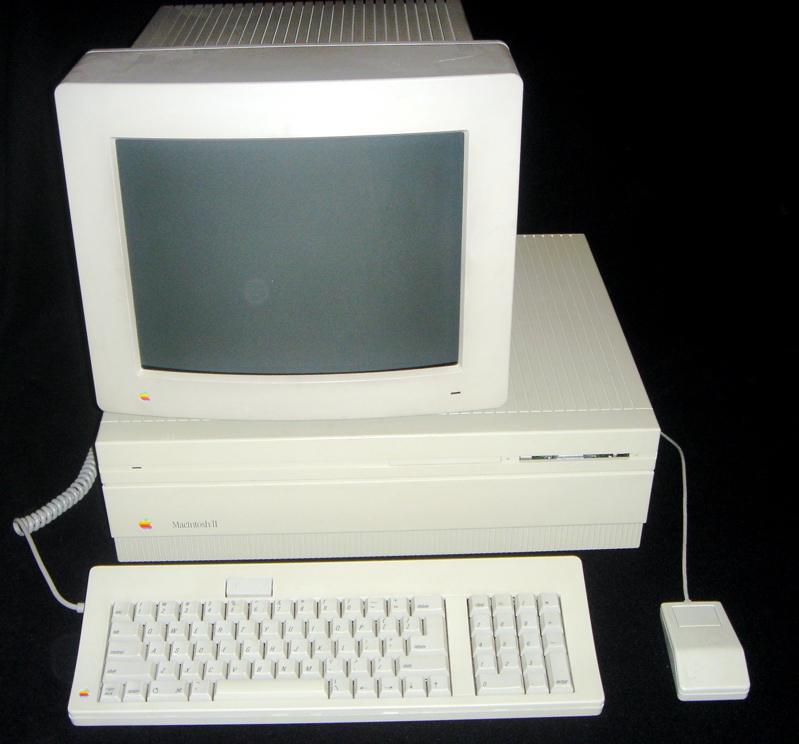
A Macintosh II with a 13-inch Apple colour monitor, like the one I bought to learn PageMaker and QuarkXPress. Photo: Ed Hurtley, CC BY-SA 3.0, via Wikimedia Commons.

Fitting the machine to the budget
Selling computers was, and still is, a volume business. The money isn’t in selling one machine. It’s in selling 30.
Education budgets were tight, and the question was usually the same: how many computers can I get for this much money? So we’d work the configuration to fit. Perhaps a slightly smaller hard drive or a little less memory, so the university could still have all 30 machines. These were the days of a couple of megabytes of memory and hard drives of 20, 40 or 80 megabytes. It sounds crazy now.
I didn’t drive at the time, so I stayed in the showroom as extra help rather than visiting universities. That’s where I made my first desktop publishing sale: a Macintosh II, a colour monitor, PageMaker, a laser printer and a scanner. As I remember it, the customer paid nearly £8,000. He was a graphic designer, I think working for himself, and he was investing in a better setup so he could do more and better work and charge more for it.
It was a lot of money, but he saw it as an investment, and one that would pay for itself.
What it taught me
The biggest lesson was this. If you’re demonstrating something, you need to understand it well enough to talk about it. You don’t have to be an expert, and you don’t have to pretend to be an expert. You just need enough knowledge to show the customer why this is the right solution for them.
And if they challenge you, you need to be able to change direction. Maybe the budget is the problem. Maybe it’s too complicated for them, or not powerful enough. That’s where I started learning to be practical.
Sometimes a customer had a real need but couldn’t afford a new machine. The shop also sold used Macs, refurbished and covered by our own warranty. So I’d suggest one. It was quite a bit cheaper, so they could get some of what they needed within their budget.
Dialling up
In 1994 I got a dial-up modem, a small box that connected my computer to the internet over a phone line, and on my wages the long-distance calls to Demon Internet soon got expensive. Around 1995 I left AppleCentre Preston to help start a local provider, UK Internet Provider, and that’s where my ISP years began.
Looking back
A lot of how I work now as a Solutions Architect started in that showroom: understanding something well enough to explain it simply, being honest rather than pretending to be an expert and shaping a solution around the need and the budget rather than the other way round.
Most of all, it taught me to keep learning. If nobody else was going to teach me, then I’d do it myself.