Writing
Preston's a long way from the internet: my ISP years
· Career
In short: In the mid-1990s I helped start an internet provider in Preston, and over nine years I taught myself how the internet works, from modem racks to peering in London. I also learned the lesson I still use as an architect: don’t rely on a single path.
Dialling Demon
In 1994 I was paying long-distance charges to dial into Demon Internet, and as far as I knew there was no local provider in Preston. That felt like an opportunity.
The web was very new, and most of what I used was still Gopher menus, FTP sites and Usenet newsgroups. I had an email address, but I didn’t really understand how a message got from me to someone else. So I used the internet itself to find out how to build one.
I looked up US Robotics modem racks, the banks of modems that customers dial into. They sit in a data centre, so then I had to learn what a data centre was, then servers, then how email actually works.
Two people who sold number plates
A friend introduced me to two people who ran a private number plate business called Newreg (New Reg). I pitched them a simple plan: the internet was going to be big, and we could sell both the connection and the services on top of it, such as websites and personalised email addresses.
It was the personalised part that clicked for them. If a business could have an address like sales
One of our first big projects was helping Newreg get online. They were among the earliest number plate dealers on the internet. The two businesses went hand in glove. I don’t think we’d have done as well without Newreg, and I don’t think Newreg would have done as well without the internet.
As Technical Director, my job was making it all work for Newreg and our other customers, mostly small businesses.
A basement, then our own data centre
We started in the basement of Newreg’s building, a small terraced house opposite the BT building in Preston, with about two racks of equipment.
When we ran out of space, we moved to a bigger building and built our own small data centre in one of the rooms, with a raised floor for the cabling, air conditioning and a UPS and diesel generator to keep the power on. The room was very loud. We also had fibre dug in from both the front and the back of the building, to reduce the risk of one digger cutting both feeds.
It was our own little data centre in the heart of Preston. Very cool, pun intended.
The hardest thing: DNS
The hardest thing I had to teach myself was DNS, the internet’s phone book, which turns a name like company.co.uk into the numeric address computers use.
Running your own name server meant editing zone files by hand on the command line. It had to be exactly right. If it wasn’t, email didn’t arrive, because the records that tell other servers where to deliver a domain’s email were wrong.
Books were hard to come by. O’Reilly’s DNS and BIND became my bible, along with the “bat book” on sendmail, the program that ran most mail servers at the time.
Seeing is believing
Our salespeople went through the Yellow Pages from A to Z, calling solicitors, accountants, plumbers and anyone else who advertised, first around Lancashire and then across the North West.
One solicitor asked me, “Why do I need email? I have a fax machine.”
I asked whether his fax could send colour pictures. It couldn’t. Email could send a spreadsheet, a drawing or a brochure, usually within minutes, from his own address.
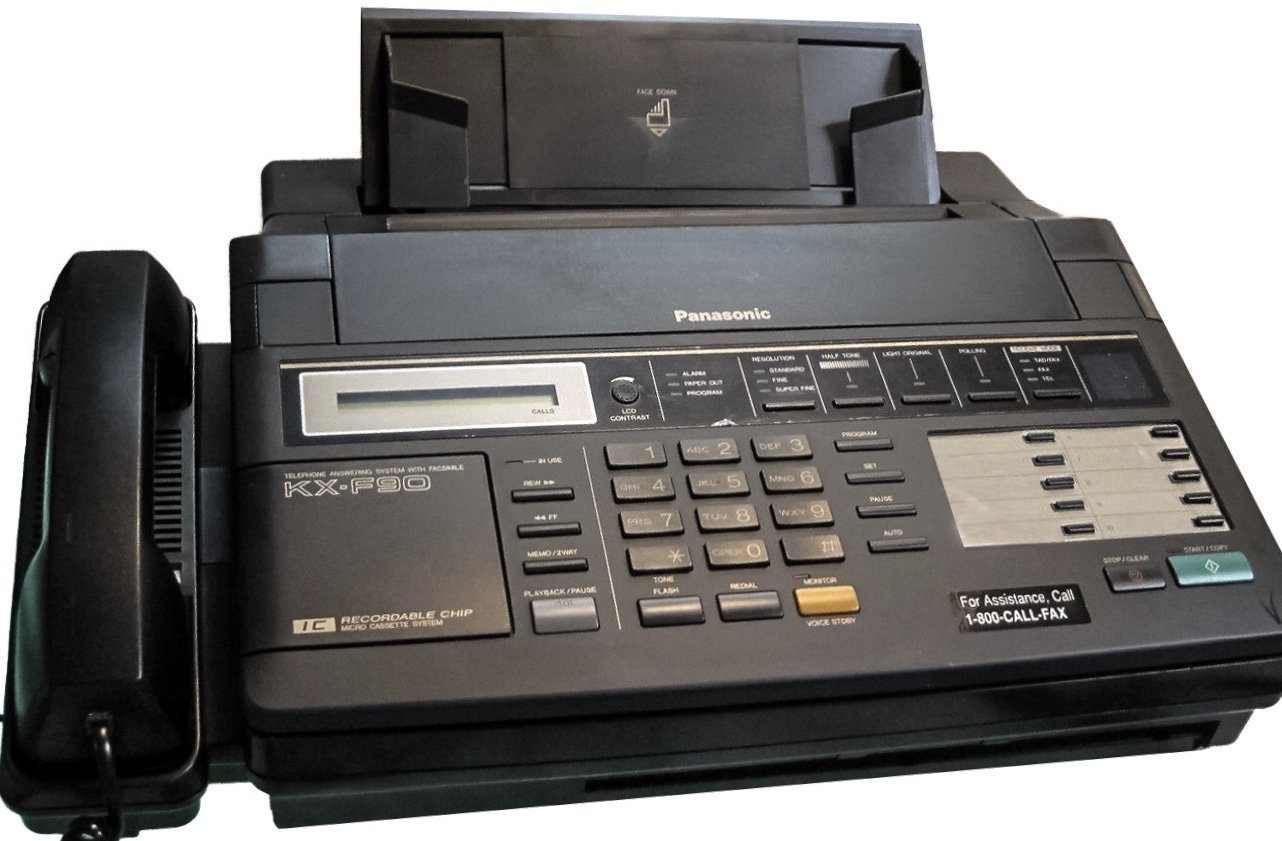
A typical office fax machine of the early 1990s. Photo: Pittigrilli, cropped by Georgfotoart, CC BY-SA 4.0.

Explaining only went so far, though. So we ran free weekly training sessions in our conference room for about ten people. I’d use Eudora, one of the early email programs, to send a test message with an attachment from one address to another. People would say “wow”. It almost sounded too good to be true until they saw it.
That was the same lesson I’d learned demonstrating Macs at AppleCentre: show people the benefit and let them see it for themselves.
Then I’d show them competitors who were already online. That usually led to the next question: “How can I get one of these websites, Jeff?” Thank you very much for asking.
As we grew, larger customers came to us. One engineering company wanted email, but its IT support firm didn’t offer it. So I agreed a deal: the support firm would resell our services and earn a finder’s fee. It opened doors, and it worked because we had a good reputation.
Downsizing
From 1995 to about 1999 I worked seven days a week. It’s not something I’m proud of. It was simply a necessity. The dream was to build the business and perhaps sell it, dot-com style. It didn’t work out like that.
The dot-com bust hit us in 2001. Our customers were cutting costs, so we had to as well. We had to downsize, and a lot of people had to go, many of them young.
Other people made those decisions, and I wasn’t the one who told anyone they were going, but I saw it all happen and it affected me too. These were people I’d worked alongside for years, and we simply didn’t have the work for them. It was one of the hardest periods of my time there.
Newreg on the North End shirt
There were good times too. In 2002 Newreg signed what Preston North End called a record shirt sponsorship deal, covering three seasons, from 2002 to 2005. That year I also became one of Newreg’s directors.
On launch day I walked out into the centre circle at Deepdale with the other directors, proudly wearing the new shirt. I’ve supported North End since I was a kid, so seeing Newreg on my boyhood club’s shirt was a moment I’ll treasure.
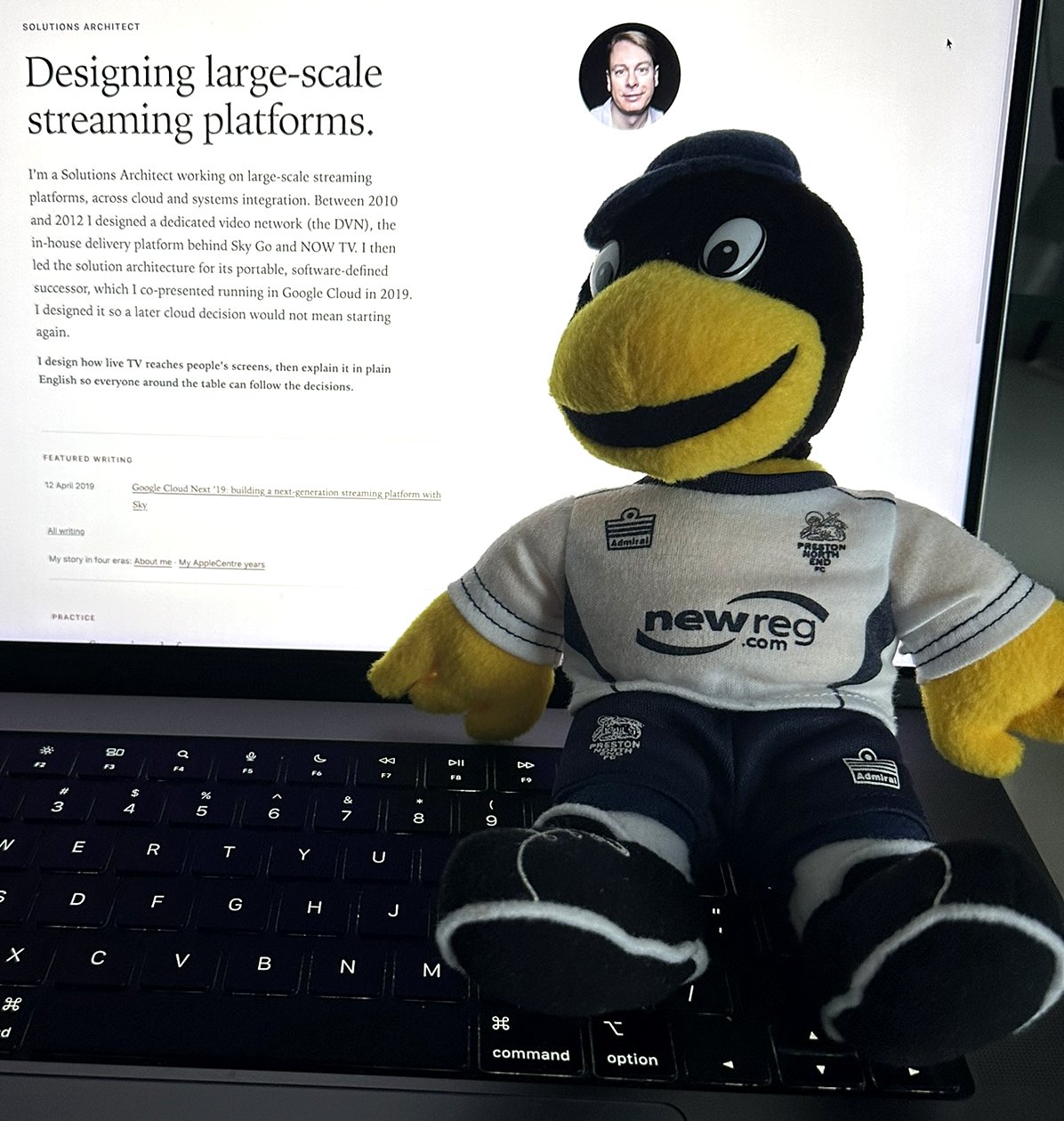
My Deepdale Duck, still in his Newreg shirt more than 20 years on.
Broadband forces a rebuild
BT launched ADSL broadband in 2000, and from 2002 it really took off. That was great for customers, but a problem for a small provider. As I remember it, broadband changed the maths. Each customer could now pull many times more than a dial-up modem, so as numbers grew our links to the rest of the internet filled up fast. We had to rebuild our infrastructure, and that was expensive. The irony was that broadband’s success forced us to start again.
Luckily, we’d already laid some groundwork. In 1999 we formed a separate company, 1A Networks Limited, to run our own network. It became a member of the RIPE NCC, the organisation that hands out internet addresses in Europe. That gave us our own block of 8,192 internet addresses and our own network number, AS12621, which identifies a network to the rest of the internet.
Peering, and Preston’s a long way from the internet
Buying “transit”, paying a bigger network to carry your traffic, was expensive. For us, peering meant swapping traffic directly with other networks at an internet exchange. Most UK networks met in London, so peering there cut our transit bill.
So I took us into the exchanges. Around 2000 our website talked about a 34 Mb link into Telehouse, one of London’s main data centres (fast for the time), and by 2002 it said we had servers there as well as in Preston. Exchange records show us at four of them. We were at LoNAP in London by 2001 and at MaNAP in Manchester and LIPEX in London by 2002. By 2002 we were at LINX, the London Internet Exchange. By 2004 our site said we peered with over 160 other ISPs, and I managed a lot of those relationships personally. I saw peering as a way to stand out. We’d already built our point of presence in Telehouse North, so joining XchangePoint for private peering was the quickest way to reach more networks, and it meant we could sell transit to other ISPs too.
Preston’s a long way from the internet. As speeds went up, so did the cost of the lines to Preston. So we moved our core equipment to London, where the exchanges and the other networks were, and connected Preston to it. It turned out cheaper and faster than bringing ever-faster lines up to Preston.
In those later years I also explored caching, which keeps copies of popular web pages close to customers, through Squid proxy servers and content delivery networks such as Akamai and Mirror Image.
What it taught me
The lesson I still use as an architect is resilience. Don’t rely on a single critical path. If there’s only one route from A to B and it gets congested or goes down, you’re dead in the water.
As I remember it, we connected Preston to London directly, and Preston to Manchester to London as well. It made a little triangle of diverse paths from different providers.
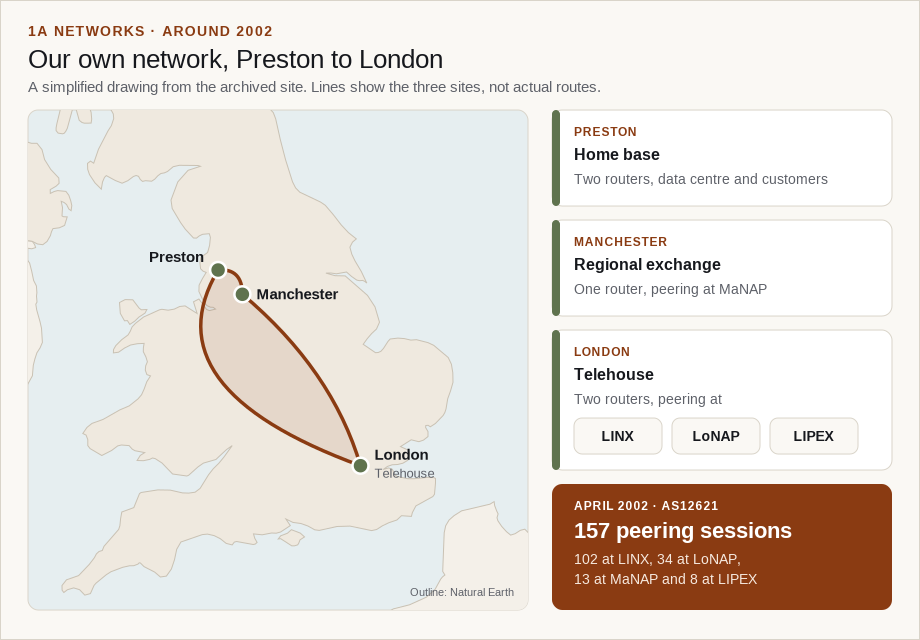
At one point our 34 Mb link to London, our fastest and most expensive, started dropping one or two per cent of its traffic. We had to take it out of service while it was tested, and that took over a week. Customers stayed online, if a little slower. We had a second route through a different provider, from Preston to Manchester and on to London, and the network simply rerouted traffic that way. When the link was fixed, traffic moved back on its own. That’s how a network should behave, and it’s by design.
Calling it a day
By 2004 the business had stopped being fun. The business was surviving, but it had become a job rather than a dream. Preston was also a small market, and my next chapter was going to be in Manchester or London.
After about nine years flat out, I took a year out, moved to London and started over.